Made where benchtops are made
Most shop software is written for a generic trade and then adapted for stone. xM-Flow went the other way.
It was designed around a real kitchen benchtop factory: slabs of engineered stone, granite, marble, porcelain and other sintered surfaces coming in at roughly 3200 × 1600 mm in 12, 20 and 30 mm; templaters out on site; installer pairs with vans and consumables; joinery companies sending most of the work; and owners who run the place on daily targets and margin. Every module started as a problem on that floor.
That's why the things that matter in a benchtop shop, like offcuts, remakes, edge profiles, cutouts, template-to-install lead times and crew capacity, are built into the core rather than bolted on.
Joinery, builders and retail: the real customer mix
In New Zealand and Australia, a big share of benchtop work comes through joinery companies, kitchen designers, architects and builders rather than straight from homeowners. Some shops also supply big-box retail kitchen programmes. Each channel behaves differently, and the software has to keep up.
One login for the joiner
Through xM-Trade, joinery clients get their own front door: they submit jobs, track them from template to install, handle quotes and invoices, and share documents with the factory, all in one login built for their business rather than for the end customer.
A CRM that tells you who to call
Open leads are ranked by stage, recency and account value. The CRM surfaces the gaps: an overdue follow-up, a quote stuck in a stage, a thin-margin job, a joinery account that's gone quiet. Each job is traced back to the trade partner who sent it, revenue and all.
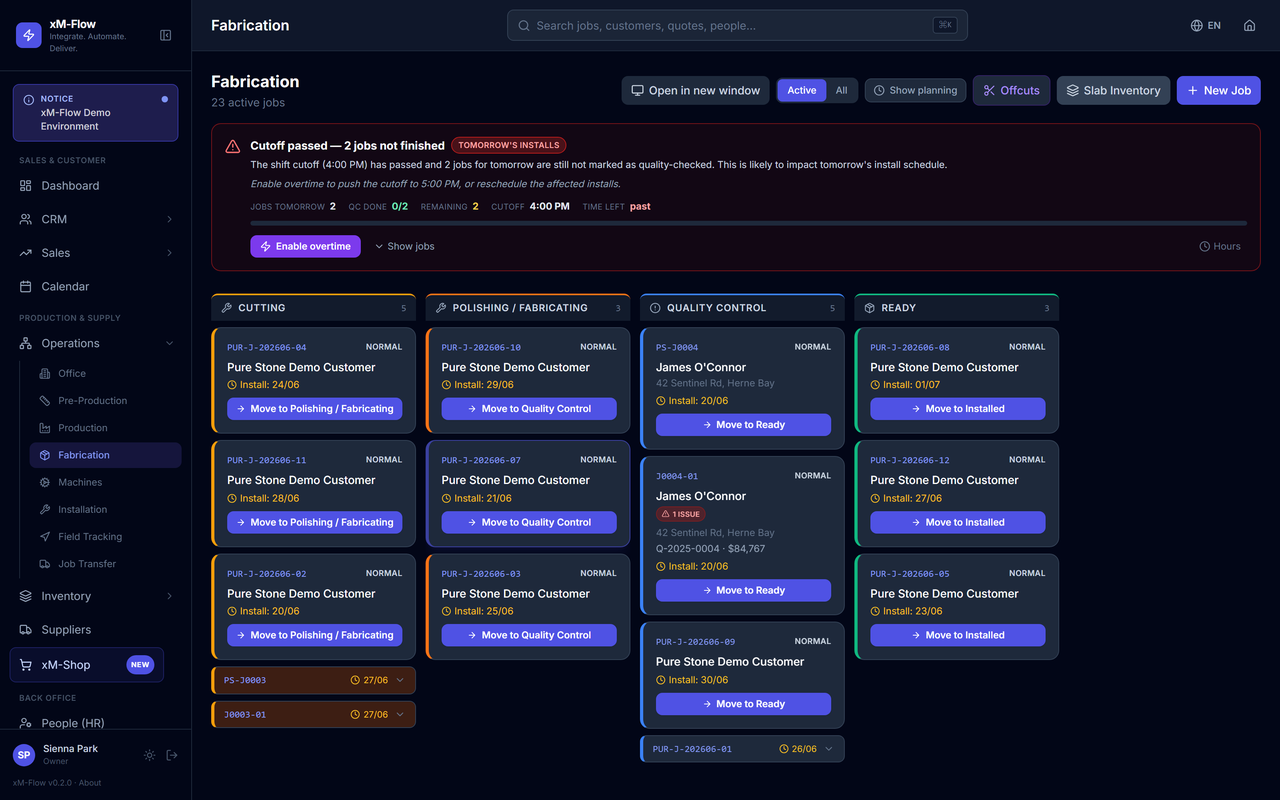
From template to install, entered once
The benchtop workflow has a well-known weak spot: the time between the sale, the template, production and the install date. Every handover is a chance to re-type a measurement or miss a date.
- Quote: priced from area, edge profiles, cutouts and live rates. With xM-Draw you draw the benchtop in 3D with the customer and show it on the actual slab from xM-Slab. More on quoting.
- Accept: accepting a quote creates the job, its pieces, the slab reservation and the schedule in one move.
- Template: templaters check in on site with a geofenced GPS check-in, and their measurements flow straight into the job.
- Produce: operators work phone-first at the machine, with the right operator and machine assigned per stage by qualification. More on the floor.
- Install: tomorrow's installs are checked against QC and crew capacity, and the installer checks in on site.
- Invoice and margin: costs have landed on the job the whole way through, so the job P&L is there when the job closes.
Xero, MYOB and GST: keep your books where they are
Benchtop shops in New Zealand and Australia usually already run Xero or MYOB, and the accountant isn't interested in switching. xM-Flow doesn't ask them to. It connects to Xero and MYOB for accounting, Stripe for card payments and WhatsApp for customer conversations.
What xM-Flow adds is the operational side the accounting package can't see: activity-based costing that allocates stone, labour, machine time, freight and overhead to the job that caused them, receivables with collection tracking, payables feeding cost per job, and cash-flow forecasts.
Running on daily targets
Benchtop factories tend to run on a daily production target. xM-Flow reads the day's jobs and the value of each, projects whether the floor will hit the target and, if it's falling short, shows what has to change, such as pulling a job forward or adding overtime on polishing. Alex, the built-in AI agent, can suggest the change. You decide.
One site or several
Single-site shops run on Growth or Pro. Groups with more than one factory use Pro+, which adds a head-office dashboard across branches, job transfers between sites with costs settled, cross-branch finance and unlimited users. See the pricing section.
Built locally
xM-Flow is built by Abilix Digital in Rolleston, New Zealand. The people who designed it understand that "the joiner moved the install" is a normal Tuesday, and the product has been shaped by that.
Frequently asked questions
What is benchtop fabrication software?
Software built for shops that fabricate and install stone kitchen and bathroom benchtops. It connects quoting, templating, slab and offcut inventory, production, installation and job costing in one system, so each job is entered once and its real margin is visible.
Does xM-Flow work with Xero and MYOB?
Yes. xM-Flow connects to Xero and MYOB for accounting, Stripe for payments and WhatsApp for customer conversations.
Can joinery clients submit and track jobs?
Yes. Through xM-Trade, joinery clients submit jobs, track them from template to install, handle quotes and invoices and share documents with the factory.
Is it only for New Zealand?
No. xM-Flow was built in New Zealand and is used for benchtop and countertop work generally. Prices on the site are shown in US dollars, excluding local tax.
We have more than one factory. Does it handle multiple branches?
Yes. Pro+ adds a head-office dashboard across branches, job transfers between sites with costs settled, cross-branch finance and unlimited users.
How do we start?
Start the 30-day free trial, no card required. Load your rates and run a real job through it in the first week.